Kundenportale



IP FAQ: Which trademark symbol should I use?
Trademarks are the cornerstone of a business identity, and successfully registering them for your organization's products or services is a cause for celebration. This is because formalizing ownership and use of this type of Intellectual Property (IP) massively increases your ability to defend a brand from imitation or unauthorized use.
And yet, distinctive, highly recognizable trademarks can do more than signal your brand to consumers. They are able to communicate a business philosophy in a flash and create a valuable emotional connection with the public. Thus, with so much to offer their owners, it is no surprise that trademarks are often eyed enviously and guarded jealously.
Demonstrating their protection status is a crucial part of any commercial strategy, and doing this begins with knowing which trademark symbol to use.
What does each trademark symbol mean?
A trademark can be any sign — such as a word, logo or slogan — that identifies your goods or services in the marketplace. The various symbols denote the extent to which a trademark is protected and, occasionally, the type of deliverables it is connected to. The most common are:
- ™: The superscript ™ symbol indicates an eligible piece of IP used in commerce as a trademark. It is usually associated with a mark that is not registered at the national or regional IP office of the territory where it appears. Legally, it signals that the user is attempting to claim IP rights to a given branding element.
- ℠: The service mark symbol has effectively the same function as its ™ counterpart, but can only be used in connection with services (as opposed to products). As with ™, a mark associated with ℠ is generally unregistered. Many jurisdictions simply use ™ for both goods and services, with the United States as a notable exception.
- ®: The superscript "circle R symbol" confirms official registration with a trademark office. It is not to be confused with the similar copyright symbol, which is a C inside a circle, and the audio copyright symbol, which is a P inside a circle (for "phonogram").
Understanding the differences: registered vs. unregistered trademark
Using an unregistered mark in commerce may grant limited common law protection, but a registered trademark carries stronger legal rights, with broader geographical scope, once approved by a national or regional authority such as the United States Patent and Trademark Office (USPTO) or the European Union Intellectual Property Office (EUIPO).
In essence, what this means is that the holder of an established but unregistered trademark might be able to prevent another entity from using a similar mark for the same goods or services in the specific area they operate. This would come down to proving who started using their mark first and whether the younger mark would create unfair competition.
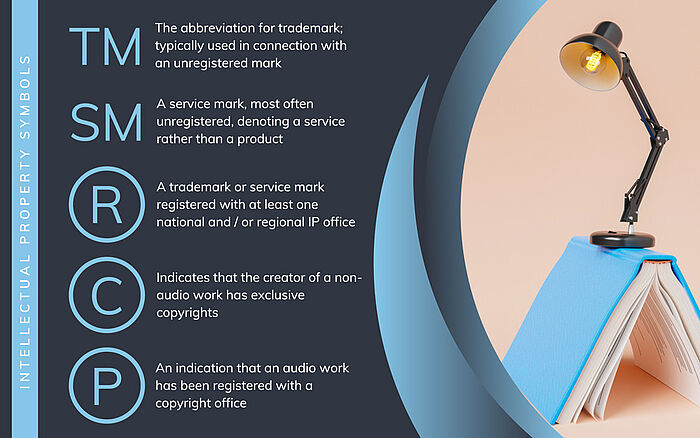
The different trademark symbols are not just for show, and using them incorrectly can have serious consequences, such as the risk of undermining your legal protections or even facing charges of misrepresentation, false advertising or fraud.
In contrast, a registered trademark is considered prima facie evidence of ownership and a right to exclude others from employing a similar mark for specified goods or services in that jurisdiction.
As an example, a small local café might display ™ alongside "Morning Roast" to indicate it is claiming the name as a trademark, even though it has not yet been officially registered. Meanwhile, a global coffee chain might have ® next to a more distinguishing name like "Beans, Steam & Cream" to show that the mark is formally registered and legally protected in the various countries where it appears.
Though a registered trademark is not immune to infringement, the chances of receiving legal remedy are greatly increased by this status. Not only that, but bad actors can be discouraged from committing transgressions by the likelihood of effective lawsuits being taken against them.
Using ™ and ® correctly
The ™ symbol can be used without formal registration to show that you are claiming a trademark, even if your mark is still pending approval or limited to a local market. The ® symbol, on the other hand, indicates an officially registered trademark recognized by a government body. Using ® prematurely or without registration can violate the law, as this can be considered a misleading business practice or even fraud.
Whether or not to register a trademark often depends on your business goals and growth plans. The ™ symbol may suffice while testing a new business name or product line. However, registration offers wider-ranging and more enforceable legal protection, especially if your company intends to expand internationally. Working with an expert trademark attorney can help you evaluate your strategy and file a proper trademark application that supports long-term brand success.

Registering your trademark might not be possible in all markets. A pre-existing mark could restrict your freedom to operate. Or, your trademark might have an unseemly meaning in another language. In both cases, rebranding is a possible solution.
Once you are confident in when and how to use the ™ and ® symbols, the next step is securing registration itself.
How to register and maintain a trademark
The first formal step in the trademark registration process is filing applications in jurisdictions where you do business. You must also search trademark databases to help ensure your mark is not excessively similar to one already registered for the product or service types you are interested in. National and regional offices provide online tools to carry out this background research.
From there, a typical trademark application includes:
- A description of the mark
- A drawing or visual representation (non-visual marks are increasingly available)
- The Nice classes of the exact goods and services designated
Next, it is time to file and pay all appropriate fees, usually defined by the number of classifications covered. While you wait for a determination, be prepared to answer any questions or requests from the registering office.
If the jurisdiction where you receive your initial registration is one of the 116 contracting parties to the Madrid Protocol, you can subsequently extend your registration to cover up to 132 countries through the Madrid System administered by the World Intellectual Property Organization (WIPO). A single basic fee is all that is required, with a 90 percent discount for trademarks originating in the least-developed countries. However, because domestic law always takes precedence over WIPO rules and IP treaties, obtaining separate trademark registration in the jurisdictions most relevant to your brand is the best way to achieve thorough protection.
Registered trademark rights can last indefinitely if renewed at the defined intervals: every 10 years in the vast majority of cases. This procedure will always involve a maintenance payment, but may also require a declaration of use or other affidavit. By staying on top of these renewal obligations and following all rules regarding trademark symbol usage, the mark and all rights relating thereto will remain in force.

Many factors play into the decision to register a particular trademark. Besides filing and maintenance costs, you must consider your overall business strategy. What markets are central to your interests? Do you prefer localized or uniform branding?
Comprehensive trademark management requires observing renewal dates across all jurisdictions and remaining vigilant for unauthorized use. In this, an IP full-service provider can alleviate the administrative burden of tracking regulations and due dates internationally and provide the legal weight to discourage and counter infringement.
Trademark symbol FAQs
What makes a good / bad trademark?
In general, a good trademark is distinctive, memorable, recognizable and easy to pronounce or spell, on top of being legally acceptable and free of conflicts. Conversely, a bad trademark could be nonspecific, confusing, deceptive or simply unattractive.
What is trademark infringement?
Trademark infringement is the unauthorized use of a trademark or service mark. This can include utilizations likely to cause consumer confusion about the source or sponsorship of goods or services.
How do trademark laws differ?
In some jurisdictions, it is not mandatory to use the ® symbol for a registered mark; in others, such as the United States, this omission could restrict the damages awarded in a successful infringement case. Additionally, non-English speaking countries and territories may employ their own linguistic variants; for example, in Canada, it is possible to use MD ("marque déposée") for a registered trademark and MC ("marque de commerce") for any trademark. The German abbreviation for "registered trademark," e.Wz. ("eingetragenes Warenzeichen"), may also be seen.
When are symbols for unregistered trademarks useful?
The ™ and ℠ symbols can be important in numerous jurisdictions for eventually securing trademark registration. The relevant IP offices will expect to see evidence of either a mark's current use in commerce or your future plans to use it. Having the appropriate symbol alongside the mark reinforces your intent to establish the IP as part of your overall brand and can support your eventual application.
What are you not allowed to trademark?
Although rules differ and specific cases may be exceptions, for the most part, you cannot trademark:
- Generic terms (e.g., "shoes" for footwear)
- Merely descriptive terms without secondary meaning (e.g., "organic oranges")
- Surnames (well-known labels can be exceptions, as with many luxury design houses)
- Marks that may be confused with existing registrations
- Grossly offensive marks
Is it possible to lose a trademark?
You can lose a trademark through various causes, including:
- Abandonment: Non-use with no intent to resume
- Legal problems: Improper licensing or third-party cancellation proceedings
- Genericide: When a mark becomes the common name for the product / service
Want to learn more about the correct usage of the trademark symbols? Need an IP attorney or other legal service? Contact the Dennemeyer team today.
Filed in

What might seem like bold and opportunistic advertising at the Olympics or World Cup can actually damage organizers, sponsors and the public.
Ambush marketing and major sports events
What might seem like bold and opportunistic advertising at the Olympics or World Cup can actually damage organizers, sponsors and the public.

WTR 1000: Global acclaim for Dennemeyer in 2026
Dennemeyer's legal experts and services recognized for global excellence.

Faux fashion: how TikTok became a runway for counterfeits
Discover how counterfeiting takes advantage of social media trends and how Intellectual Property rights help brands reclaim their authenticity.

Can I copyright a name, and why a trademark might be the answer?
Trademarks, rather than copyrights, are the preferred way to protect a business name.

Get the updates in your inbox
Subscribe to get the latest news and updates.
No spam. We promise.