Log in



What is a utility patent? Your complete guide to protection in the United States
Patents are a cornerstone of Intellectual Property (IP) protection, empowering inventors with exclusive rights to make and use their creations while sharing the technical knowledge that fuels progress. Without these vital registrations, technological advances would be curtailed by a combination of corporate secrecy and the fear of reverse engineering.
It is no surprise then that the United States is one of the most popular filing destinations globally, with its national office receiving 603,194 utility patent applications in 2024 alone. Of these, 333,125 originated from outside the country – the highest total in the world – meaning it is crucial for innovators everywhere to have a grasp of this type of IP right conferred by the United States Patent and Trademark Office (USPTO).
It all starts with what utility patents are, how they differ from similar grants and what steps are involved in registration.
What is a utility patent?
First off, there is the nomenclature. Sometimes called a "patent for invention" in legal contexts, a utility patent is, in the United States, what would simply be labeled a "patent" in most other jurisdictions. Indeed, even in the United States, the term "patent" is used generally wherever it is clear that the "traditional" or "conventional" notion of this IP right is being referenced.
What, then, is one of these patents so far as U.S. law is concerned? Under Title 35 U.S.C. §101, "Whoever invents or discovers any new and useful process, machine, manufacture or composition of matter, or any new and useful improvement thereof, may obtain a patent therefor, subject to the conditions and requirements of this title." In other words, a utility patent safeguards the functional or operational aspects of an invention — be it a method, an appliance, a fabricated article or a novel substance such as an alloy or pharmaceutical.

A utility patent may cover many more types of subject matter than the mechanical. Electronics, synthetic materials and, in some instances, even software can be eligible.
Thus, utility patent protection focuses on the technical effects of structure, behavior, chemical composition, algorithms and so on. By contrast, a design patent safeguards ornamental or aesthetic features, such as shape, configuration or surface decoration, but does not cover functional elements.
As in most parts of the world, utility patents in the United States typically last 20 years from the filing date, subject to maintenance fees. Unusually, these renewals do not follow an annual schedule; instead, they are payable 3-3.5 years, 7-7.5 years and 11-11.5 years after the date of issue, with a surcharge for payments made up to six months after the closure of each of these periods. This consolidates patent maintenance into fewer but larger disbursements that scale over time. Although payments can be significant, considerable discounts apply for both small and micro entities.
With a grasp of a utility patent's scope and definition, the next step is understanding the process of obtaining one and how a careful strategy can safeguard both your invention and its commercial value.
How to obtain a utility patent
Though the journey to a utility patent can be complex and lengthy, a structured approach will improve your chances of success. Each of the following stages plays a critical role in securing enforceable protection.
1. Confirm eligibility
Your invention must satisfy a number of statutory requirements, principally novelty, non-obviousness and usefulness. This last requirement means the invention must credibly perform a function that provides an identifiable benefit. An invention whose operation is purely speculative or impossible, such as a teleporter or perpetual motion machine, will fail this test.

Utility patent protection is a highly strategic resource, but acquiring it in the first place requires a significant investment of time, money and intellectual capital.
2. Consider a patent search
A search helps identify similar concepts and / or inventions in the prior art (i.e., the state of the art) that may serve to block your claims or require a narrower scope. However, it is important to remember that no search is all-inclusive, nor a foolproof way to uncover all prior art and / or avoid accusations of copying nor insulation against being found liable for infringement of another's patent rights. After reflecting on your own IP environment, a patent search can be a useful tool in assessing your invention's patentability and guiding claim drafting.
3. Prepare your application
A full utility patent application includes several critical components, for which a specialist attorney's drafting expertise will be invaluable.
- Specification: This provides a detailed description of the invention.
- Claims: These define the legal scope of protection.
- Dependent claims: These refer back to other claims and can be included to cover variations of the invention.
- Drawings: Many inventions require clear technical illustrations to convey their form and operation accurately.
4. File your utility patent
In the United States, it is strongly recommended that you file a non-provisional utility patent application online through the USPTO's Patent Center. Alternatively, you can file by mail, but note that paper filing incurs additional costs. As part of the patent filing process, you are required to pay filing, search and examination fees.

A utility patent's limited monopoly affords innovators a window of market exclusivity that can help fund further research and development efforts.
5. Examination by the USPTO
An examiner reviews your application, compares it against existing prior art and issues actions such as a request for clarification. You must respond to all office actions within prescribed time limits, often with explanatory arguments or amendments to your claims. The majority of utility patent applications initially receive a non-final rejection, so this process is to be expected. Bear in mind that though multiple rounds of office actions may occur, a rejection after a second examination is often final, but may be revived with a formal request and payment of a fee.
6. Approval or rejection
If approved, your patent will be granted. If rejected by the USPTO, you may file appeals or petitions with the Patent Trial and Appeal Board (PTAB). Throughout this process, you will incur various costs, including official fees and, most likely, legal advice, so balancing these is part of a sound patent management strategy.
Although the utility patent application process is rigorous, selecting and executing the right IP strategy improves the chances of success and can help maximize the commercial value of a portfolio. Creating a well-planned approach begins with an appreciation of how utility patents compare to related IP types and when multiple forms of protection may be overlapped.
Utility patents vs. other patent types
Inventors often ask how utility patents differ from other types of patent protection. Here are some of the key distinctions between utility patents and other common patent categories in the United States.
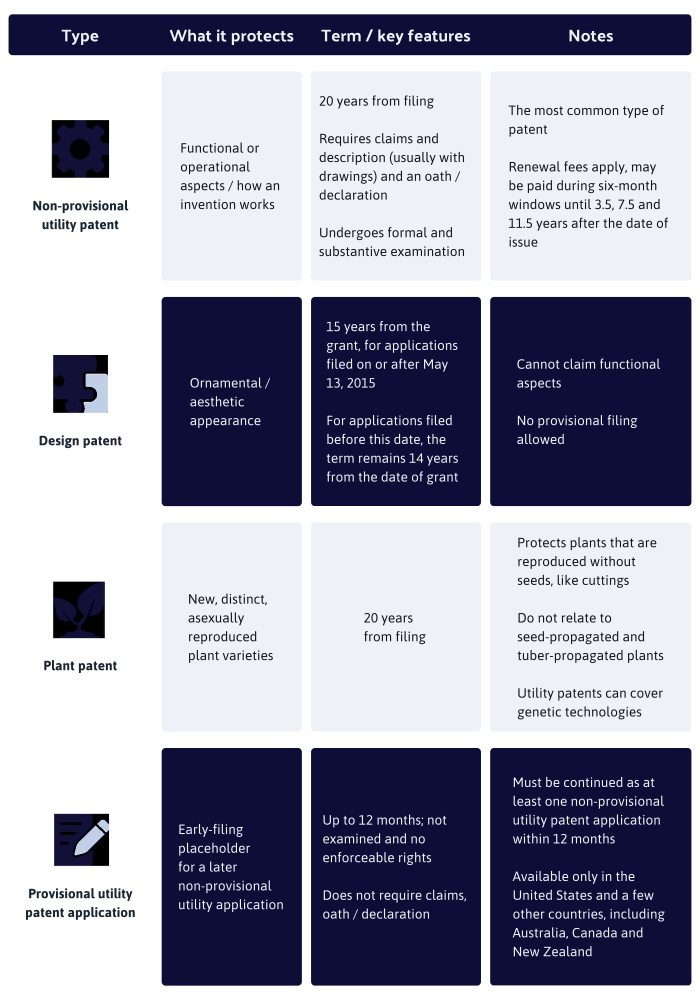
In many cases, a single invention may span multiple types of IP rights. For instance, a new ergonomic chair could be protected by a design patent for its unique shape. In contrast, a utility patent could cover an innovative reclining mechanism or adjustable support system. Concurrent filings are common when both form and function merit protection.
Frequently asked questions
How long does it take to get a utility patent approved?
The timeline varies with complexity, backlog and responsiveness. On average, U.S. utility applications reach final disposition after around 25 months or more. Some applicants may accelerate the process by using the USPTO's Track One program, which generally reaches a decision on the merits in 12 months or less.

In 2023, the USPTO fully replaced its legacy filing and management systems for patent applications. Consolidating all actions in the Patent Center makes the process simpler and more secure for the Office's customers.
What happens after a utility patent expires?
Once its patent term ends – through early abandonment, cancellation or the completion of the 20-year maximum – an invention enters the public domain. At this point, anyone can make, use or sell it without seeking permission. After expiration, no enforcement against further uses is possible.
What if I disclose before filing?
In the United States, there is a one-year grace period from disclosure by an inventor — such as in research papers or during presentations — to file a patent application. Most other jurisdictions do not offer the same grace period. Publicly disclosing your claimed invention before filing can jeopardize patent rights abroad, meaning it is best to file before any disclosure when seeking international protection.
What is the average cost of a utility patent?
The cost of a utility patent varies widely based on complexity, technology, the number of embodiments and the legal services provided. With the support of an attorney, a complete utility patent application for a low-complexity invention would likely cost a four-figure sum in total. A utility patent application for a more complex invention would probably be several times that sum. When including prosecution, maintenance and possible responses and appeals, total lifetime patent costs over 20 years may reach into the tens of thousands. Government fees depend on entity size and filing method, so consulting a patent attorney early helps plan a realistic budget and strategy.
Ready to protect your innovations? Contact us to explore how Dennemeyer can help in the United States and around the world.
Filed in

Discover the ins and outs of maintaining patents, including strategies to manage budgets, due dates and ongoing value.

Reflecting on past developments and recent trends to conceptualize the possible course of Intellectual Property over the next 25 years.

New dawn or damp squib? Mediation and arbitration at the UPC
Will the opening of the UPC's Patent Mediation and Arbitration Centre lead to more alternative dispute resolution in European patent cases?

University IP and the role of AI in technology transfer
New methods of using artificial intelligence (AI) are helping to get inventions from the research lab to the marketplace more efficiently.
Invent horizon: imagining the patent system in 2050
Reflecting on past developments and recent trends to conceptualize the possible course of Intellectual Property over the next 25 years.
Your go-to guide to patent renewals
Discover the ins and outs of maintaining patents, including strategies to manage budgets, due dates and ongoing value.

Get the updates in your inbox
Subscribe to get the latest news and updates.
No spam. We promise.